Tattoo ink sits inside the dermis, while uneven colour around a tattoo can come from healing, inflammation, melasma, scarring or an unrelated skin condition. You will learn how to identify the likely cause, understand why laser choices differ by ink colour, and judge what a safe treatment plan should include.
Key takeaways
- Laser pulses fragment tattoo ink; immune cells clear it between sessions.
- Uneven colour can indicate residual ink, post-inflammatory pigmentation, or another skin condition.
- Ask about laser wavelength, test spots, skin type, and risks before treatment.
- Protect healing skin from sun exposure to reduce pigmentation changes after laser treatment.
Why tattoo ink responds differently to laser treatment
Tattoo ink remains because it is deposited in the dermis, beneath the surface epidermis. Macrophages capture the particles but retain and redistribute them within deeper tissue, so creams, scrubs and chemical peels cannot reliably remove the design. Laser treatment uses selective photothermolysis: short, high-energy pulses break pigment into smaller fragments that immune cells gradually clear.
Pigment colour affects how much laser energy it absorbs and which wavelength can target it safely.
| Colour | Typical laser response | Why the approach differs |
|---|---|---|
| Black | Often responds well | Absorbs several commonly used wavelengths efficiently |
| Dark blue | Often responds well | Absorbs many of the same wavelengths as black |
| Green | Variable | May require a wavelength that targets green without overheating surrounding skin |
| Red | Variable | Needs a colour-specific wavelength; reactions to red pigment also require caution |
| Yellow | Often resistant | Reflects more laser light, so fewer particles absorb useful energy |
| White | Unpredictable | Reflective or mineral-containing pigments can resist treatment or change colour |
One device or setting cannot safely treat every tattoo because colour, ink depth, density and your baseline skin tone change the risk of burns and uneven pigmentation. A dermatologist in nashik for tattoo ink and pigmentation should assess the colours and perform a small test spot when the ink composition or response is uncertain.
Even appropriate treatment can leave ghosting, residual pigment or temporary lightening or darkening.
Is the uneven colour leftover ink or a separate pigmentation problem?
Colour that follows the tattoo’s lines and remains within its edges is more likely residual ink. Colour outside the design points toward a separate skin process, especially when it appeared after irritation, infection or laser treatment.
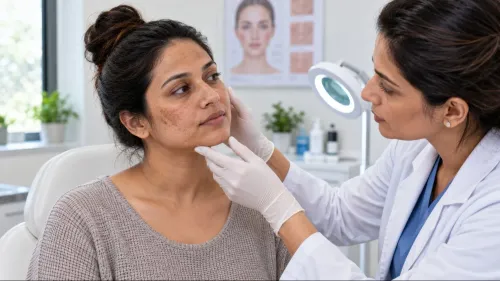
A skin pigmentation doctor in Nashik examines these clues:
1. Post-inflammatory hyperpigmentation follows a healed rash, burn, acne lesion or tattoo reaction. Melasma forms fairly symmetrical brown patches, usually on the cheeks, forehead, upper lip or nose; a birthmark has often been present for years.
Drug-related pigmentation may be diffuse or repeat in areas exposed to the medicine, while a fungal infection can produce an itchy, scaly or ring-shaped patch.
2. Scar tissue feels raised, firm, indented or textured rather than simply discoloured. Vitiligo creates sharply pale or white patches with clear borders, not leftover dark pigment. Residual ink stays mapped to the tattoo, although pigment can blur beyond fine lines.
3. Red ink can trigger a delayed reaction years later. Itch, swelling, scaling, pain or firm nodules signal inflammation, not routine fading.
Do not laser an actively itchy, swollen or infected tattoo, a raised scar, or a changing mole before examination. Laser energy can worsen inflammation, release allergenic fragments, or destroy tissue needed for diagnosis. A suspicious dark area may need dermoscopy and biopsy instead of cosmetic removal.
A tattoo removal doctor in Nashik should assess it first.
What should be checked before choosing a tattoo-removal laser?
Before the first pulse, the assessment must record the tattoo’s colour, age, application method, depth, density, location and your baseline skin tone.
- Note whether it was professionally applied or an amateur tattoo, which often has uneven depth.
- Record keloid or raised-scar history, smoking status, medication names, allergies and previous laser, saline, surgical or chemical removal attempts.
- Photograph the area and mark any existing pigmentation, scars, moles or inflammation before choosing settings.
| Colour | Wavelength approach | Key consideration |
|---|---|---|
| Black or dark blue | 1064 nm commonly targets deeper dark pigment | Often responds better, but depth and density still matter |
| Green | 755 nm or 694 nm may be selected | Dense green ink can need cautious staging |
| Red, orange or brown | 532 nm may target suitable pigments | Check for inflammatory reactions and mixed colours |
| Yellow, white or flesh-tone | Requires specialised assessment and testing | Titanium dioxide or mixed pigments can respond unpredictably |
Cosmetic pigments containing iron oxides or titanium dioxide can turn grey, black or brown after laser exposure. If the composition is unknown, request a small test spot first; it shows how that pigment and your skin react before treating the full tattoo.
Ask a tattoo removal doctor in Nashik whether examination and a test area are appropriate, which wavelength matches each colour, and how prior treatment changes the plan. Dr. Shreeya: Consultant Dermatologist is one local option for discussing those checks without assuming complete removal or a specific result.
Related services
Cosmetic Dermatology (Aesthetic Medicine) Tatto Removal And Skin Pigmentation Tatto Removal And Skin Pigmentation View service → |
Clinic Dermatology Treatment for Skin Pigmentation & Related Disorders Treatment for Skin Pigmentation & Related Disorders View service → |
Why tattoo removal takes several sessions instead of one visit
A laser session does not remove tattoo ink in one sweep. Short, high-energy pulses fragment pigment particles, but your immune cells must gradually carry those fragments away through the lymphatic system. Treating again too soon can add inflammation before the skin and immune response have settled, so sessions are commonly spaced 6–8 weeks apart.
The total treatment time depends on:
- Dense or deeply placed ink, which takes more treatment cycles to break down
- Pale or resistant colours, which absorb available laser wavelengths less effectively
- A large tattoo, because each session covers a greater area
- Lower-body locations, where slower circulation can delay clearance
- Older or amateur ink patterns, which may sit at uneven depths
- Smoking, which can impair healing and circulation
- Your individual immune response, which determines how quickly fragments are cleared
Previous removal attempts change the starting assessment. They can leave patchy pigment, altered skin texture, scarring or inflammation, so a dermatologist in Nashik must assess the remaining ink and skin before choosing settings.
Even a well-planned course cannot guarantee complete removal. Residual pigment, faint “ghosting,” textural change, scarring, and lighter or darker skin can remain. A persistent itchy, swollen or painful tattoo needs examination before another session, because active inflammation can worsen with laser treatment.
What healing looks like, especially on darker Indian skin
After a laser session, the treated tattoo can look worse before it looks better. Expect short-term redness, swelling, pinpoint bleeding or blistering, followed by crusting and gradual fading.
| Healing stage | What you may notice | What to do |
|---|---|---|
| First hours | Redness, warmth, swelling or pinpoint bleeding | Follow the wound-care instructions |
| Next few days | Blisters, crusts and temporary darkening | Keep the area clean; do not pick or peel crusts |
| Following weeks | Fading, lightening, darkening or patchy colour | Protect the area from sunlight and allow healing time |
Medium-to-dark Indian skin has a higher risk of post-inflammatory hyperpigmentation or hypopigmentation after irritation or laser injury. Temporary uneven colour does not prove that the laser failed, but unchanged skin colour cannot be guaranteed.
Avoid direct sun exposure during recovery and use a broad-spectrum sunscreen on healed skin. Sun protection is part of the treatment, not an optional cosmetic step; ultraviolet and visible light can deepen pigmentation.
Contact your clinician for worsening pain, pus, spreading redness, persistent itch or swelling. Do not continue laser treatment over an active infection or unexplained reaction.
If colour extends beyond the tattoo or persists after healing, seek a proper diagnosis before choosing pigmentation treatment in Nashik. Unsupervised steroid-containing fairness creams can thin skin, trigger acne-like eruptions and mask the underlying condition.
Frequently asked questions
Why does tattoo ink respond differently to laser treatment?
Tattoo pigments vary in colour, chemical composition, particle size, and depth. Laser wavelength and pulse settings must match the pigment because one setting cannot safely treat every ink colour.
Is uneven tattoo colour leftover ink or a separate pigmentation problem?
Uneven colour can result from remaining tattoo ink, post-inflammatory hyperpigmentation, hypopigmentation, or an unrelated skin condition. A dermatologist must examine the area before selecting treatment.
What should you check before choosing a tattoo-removal laser?
Ask which laser wavelength will target each ink colour, whether a test spot is planned, who will perform the procedure, and how the clinic will reduce risks of burns and pigmentation changes.
Why does tattoo removal take several sessions?
Each session breaks only part of the pigment into fragments that the body clears gradually. Sessions are spaced apart to allow healing and immune clearance before another treatment.
What does healing look like after tattoo removal on darker Indian skin?
Redness, swelling, crusting, temporary darkening, or lightening can occur after treatment. Careful wound care and strict sun protection help limit pigment changes, which require assessment if they persist or worsen.
Related services
Cosmetic Dermatology (Aesthetic Medicine) Dermapen For Skin Rejuvenation Acne Scarring, Stretch Marks, Pigmentation Dermapen For Skin Rejuvenation Acne Scarring, Stretch Marks, Pigmentation View service → |
Cosmetic Dermatology (Aesthetic Medicine) Microblading & PMU (Permanent Makeup) Microblading & PMU (Permanent Makeup) View service → |
Clinic Dermatology Vitiligo Management View service → |
Keywords