Hair shedding is not always hair loss, and waiting for regrowth can be unhelpful when the scalp shows a medical disorder. You will be able to match your symptoms to the right level of care, understand the tests and treatments a dermatologist may use, and compare medical treatment with procedures, transplantation, monitoring, and cosmetic cover.
Key takeaways
- See a dermatologist for sudden shedding, visible thinning, scalp changes, or patchy hair loss.
- Ask which diagnosis and tests explain your hair loss before choosing treatment.
- PRP and GFC suit selected cases; they do not replace diagnosis or proven medical care.
- Choose monitoring, treatment, concealers, or transplantation based on cause and progression.
When Does Hair Shedding Need a Dermatologist’s Assessment?
About 50–100 shed hairs per day is commonly estimated as normal. Short-term monitoring is reasonable when shedding is mild, recent, and the scalp looks healthy, with no reduction in density.
Seek assessment sooner if you notice:
- A widening part, receding temples, visible scalp, increasing shedding, or broken hairs
- A smooth patch, sudden bald spot, or loss of eyebrow or eyelash hair
- Nail changes, scalp pain, burning, pus, scale, marked redness, or shiny skin without follicular openings
These warning signs need prompt review because scarring alopecia can permanently destroy follicles. Do not wait for spontaneous regrowth when shedding continues beyond a short period, density is falling, or scalp symptoms are present.
Your age, sex, duration of loss, and family history help distinguish androgenetic alopecia from telogen effluvium, alopecia areata, traction alopecia, fungal infection, psoriasis, seborrheic dermatitis, or scarring alopecia.
Tell the dermatologist about childbirth, fever or surgery two to three months earlier, major stress, rapid weight loss, restrictive dieting, new medicines, tight hairstyles, chemical treatments, and menstrual irregularity; each can change the urgency and likely cause.
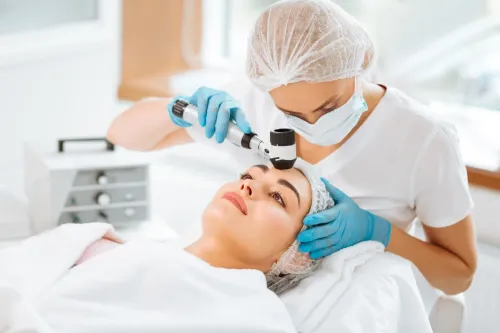
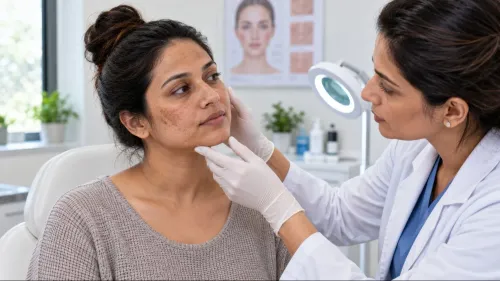
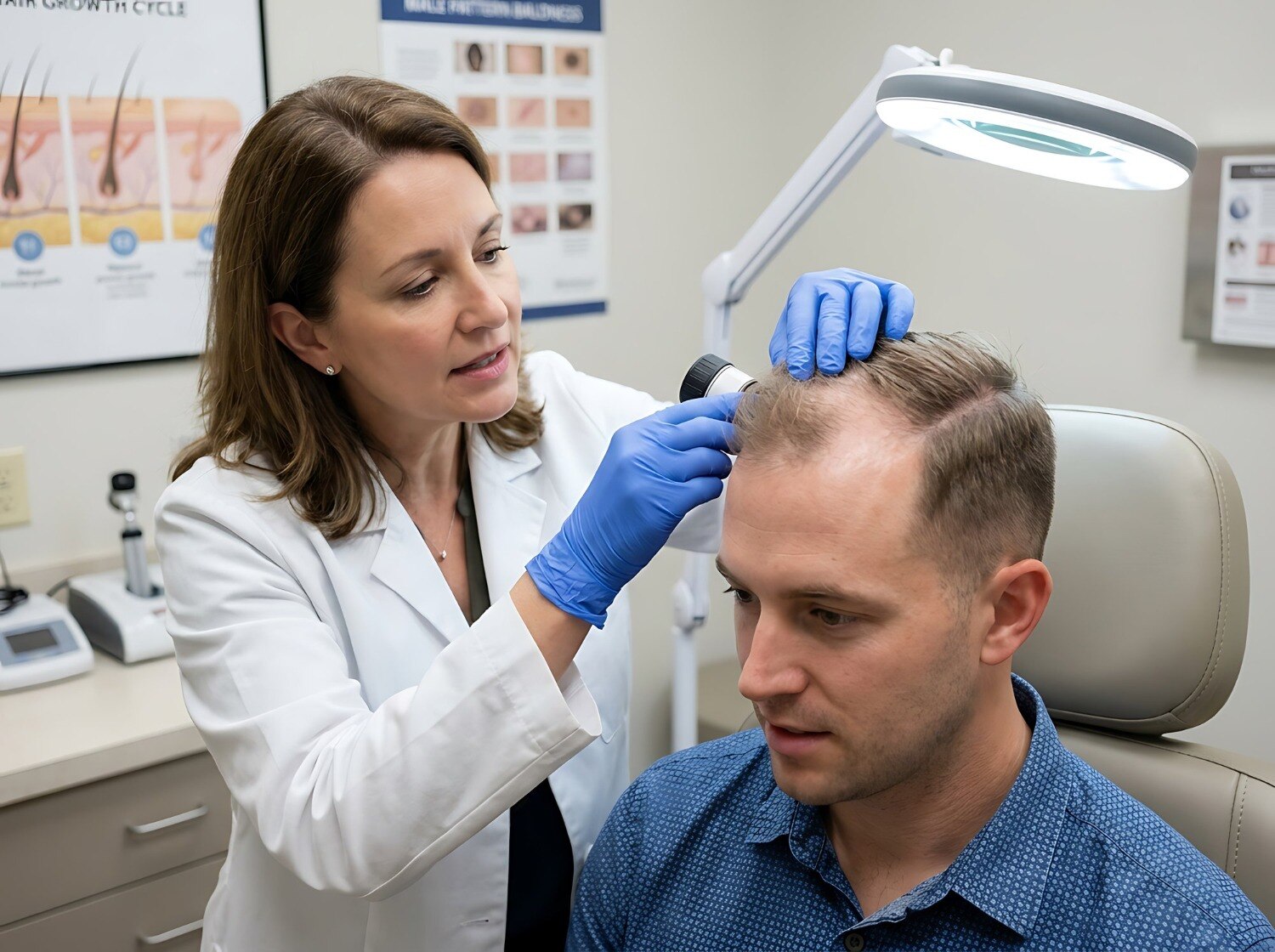
A consultation may include scalp inspection, a hair-pull test, and dermoscopy. A complete blood count, ferritin, TSH, vitamin B12, vitamin D, or scalp biopsy is selected according to your history and examination, not ordered automatically. Hair loss management in Nashik should begin with diagnosis; a commercial hair-growth package cannot replace it.
What Conditions and Tests Must a Dermatologist Separate?
An accurate evaluation separates increased shedding from reduced hair density. The main possibilities include androgenetic alopecia, telogen effluvium, alopecia areata, traction alopecia, fungal scalp infection, scalp psoriasis, seborrheic dermatitis, and scarring alopecia.
1. The dermatologist reviews timing and triggers: recent fever or surgery, major stress, rapid weight loss, restrictive diets, new medicines, childbirth, menstrual irregularity, family history, tight hairstyles, and chemical treatments.
2. The clinician inspects the scalp and hair shafts. A hair-pull test assesses active shedding, while dermoscopy can reveal follicular openings, miniaturized hairs, broken hairs, scale, inflammation, or signs of scarring.
3. Blood tests are selective, not automatic. A complete blood count and ferritin fit diffuse shedding or suspected iron deficiency; TSH fits thyroid symptoms or relevant history; vitamin B12 fits dietary restriction or deficiency risk; and vitamin D fits supporting symptoms, history, or examination findings.
4. A scalp biopsy is reserved for unclear cases or suspected inflammatory and scarring alopecia. It can identify disease when the surface examination cannot.
Judge the best dermatologist in Nashik by diagnostic practice, not a ranking label. Verify National Medical Commission registration, ask about experience with hair and scalp disorders, confirm access to dermoscopy, and expect a diagnosis before treatment is proposed. A treatment package offered without this work-up can target the wrong condition and delay care.
Which Treatments Fit the Cause, and How Long Do They Take?
A diagnosis determines whether you need follicle-directed treatment, correction of a medical problem, or time for recovery. For pattern hair loss, topical minoxidil is an evidence-based first-line option for many adults, but early temporary shedding, scalp irritation, and unwanted facial hair can occur. Continued use is needed to maintain its benefit.
| Cause | Treatment | Time and expectations |
|---|---|---|
| Pattern hair loss | Topical minoxidil | Assess response after several months; benefit fades after stopping. |
| Male pattern hair loss | Prescription finasteride | Mainly used for men; effects take months and continue only during treatment. Discuss sexual adverse effects and mood symptoms with the prescriber. Pregnant people must not handle crushed or broken tablets because of fetal risk. |
| Documented iron, vitamin D, zinc, or B12 deficiency | Replace the deficient nutrient and address its cause | Improvement follows correction, not the supplement alone. |
| Inflammation, fungal infection, psoriasis, or seborrheic dermatitis | Disease-specific medicines | Hair recovery depends on controlling the scalp condition. |
| Telogen effluvium | Correct the trigger or underlying illness | Shedding often starts two to three months after an illness, stressor, surgery, or dietary change and improves after the trigger is addressed. |
| Alopecia areata | Corticosteroids or other prescription treatments | Response and relapse vary with the extent, duration, age, and site of loss. |
Supplements do not reliably treat pattern baldness, and excessive doses can harm you. A hair growth treatment in Nashik should not promise permanent regrowth or sell a package before identifying the cause.
The same standard applies to hair loss management in Nashik: match the treatment to the diagnosis, then judge progress over months rather than days.
Are PRP and GFC Appropriate for Your Type of Hair Loss?
An injectable belongs alongside diagnosis-based treatment when pattern hair loss is confirmed; it should not replace treatment for an underlying disorder. PRP uses your processed blood and platelet-rich fraction, while GFC uses a processed preparation of concentrated growth factors. GFC preparation differs between clinics, so ask for the process before consenting.
| Procedure | What it uses | Appropriate role |
|---|---|---|
| PRP | Your blood, processed to concentrate platelets | Adjunct for selected pattern hair-loss cases |
| GFC | A preparation of concentrated growth factors | Adjunct when the doctor explains its formulation and target |
| Medical treatment | Cause-specific medicines or correction of disease | Required for thyroid disease, iron deficiency, infection, inflammation, or scarring alopecia |
Ask three questions before paying for sessions:
- What diagnosis is this procedure targeting?
- What outcome will you measure: reduced shedding, hair count, shaft thickness, or standardized photographs?
- What is the next step if it fails?
A commonly used plan involves about three sessions spaced four to six weeks apart, but your diagnosis and response determine the final number. Expect brief injection discomfort, pinpoint bleeding, and temporary swelling or tenderness. Avoid vigorous scalp rubbing and unapproved products immediately afterward; judge progress over several months, not several days.
PRP and GFC are different from low-level light devices and microneedling. Those options use different protocols, evidence, and follow-up requirements. Dr. Shreeya: Consultant Dermatologist should explain these differences and document a baseline before recommending one.
Related services
Clinic Dermatology Hair Loss Management And Treatment Hair Loss Management And Treatment View service → |
Cosmetic Dermatology (Aesthetic Medicine) PRP and GFC for Hair Fall Treatment PRP and GFC for Hair Fall Treatment View service → |
How Should You Choose Between Medical Care, Transplantation, Concealers, and Monitoring?
Choose medical care for active pattern loss or an underlying disorder, monitoring for mild stable shedding without warning signs, concealment for appearance today, and transplantation only when donor supply and long-term planning support it.
| Option | What it does | Main limitation |
|---|---|---|
| Medical care | Treats pattern loss or an underlying cause | Follow-up is needed, and response often takes several months to judge |
| Monitoring | Tracks stable, mild shedding | It is unsafe when patches, scalp symptoms, or progressive thinning appear |
| Fibres, powders, sprays, hairpieces | Conceals visible scalp | It does not treat follicle disease |
| Transplantation | Redistributes existing donor follicles | It does not stop miniaturization in untreated native hair |
For monitoring, take photographs with the same lighting, angle, hair length, and camera distance. A transplant consultation must cover donor density, scarring, graft survival, achievable density, and possible future procedures; inadequate donor hair or unmanaged ongoing loss can produce disappointing coverage.
Before choosing a hair specialist doctor in Nashik, ask for:
- National Medical Commission registration
- A baseline scalp examination and standardized photographs
- The diagnosis in plain language
- Expected review dates and the time needed to assess response
- A plan to protect native hair if transplantation is considered
Judge a search for the best dermatologist in Nashik hair loss care by diagnostic skill, dermoscopy experience, and medical and surgical judgment—not the label “best.” A commercial package without a diagnosis can delay effective treatment.
Frequently asked questions
When does hair shedding need a dermatologist’s assessment?
Book an assessment for sudden or persistent shedding, visible loss of density, patchy bald spots, scalp symptoms, or hair loss with illness or medication changes. Mild, recent shedding with a healthy-looking scalp and stable density can be monitored briefly.
What conditions and tests must a dermatologist separate?
A dermatologist separates pattern hair loss, telogen effluvium, alopecia areata, traction alopecia, scalp infection, inflammatory disease, and hair-shaft disorders. The assessment can include scalp examination, dermoscopy, a hair-pull test, and blood tests such as a complete blood count, ferritin, thyroid-stimulating hormone, or other tests guided by your history.
How long do hair loss treatments take to work?
The timeline depends on the cause and treatment. Your dermatologist should explain when reduced shedding, visible regrowth, and treatment review are expected. Do not judge a treatment after only a few days or stop it without clinical guidance.
Are PRP and GFC appropriate for every type of hair loss?
No. PRP and GFC are procedure-based options for selected patients, often after a diagnosis of a suitable form of hair loss. They are not substitutes for treating scalp disease, correcting a deficiency, or addressing an underlying medical trigger.
How should you choose between medical care, transplantation, concealers, and monitoring?
Use monitoring when shedding is mild and density remains stable. Choose medical care when an active cause needs treatment, concealers when you need immediate cosmetic coverage, and transplantation only after the diagnosis, donor supply, progression, and long-term plan have been assessed.
Related services
Clinic Dermatology Dandruff Dandruff |
Hair Related Disorders (Greying Of Hair) Hair Related Disorders (Greying Of Hair) View service → |
Keywords